
Turn Community Into a Marketing Strategy
But some coffee brands are taking that behavior a step further.
Turn Community Into a Marketing Strategy

Why events, shared interests, and real-world experiences can turn a coffee shop into something people want to belong to.
Coffee has always been social.
People meet over coffee, work from coffee shops, catch up with friends, hold meetings, go on dates, and build routines around their favorite cafés.
But some coffee brands are taking that behavior a step further.
Instead of thinking of themselves only as places that sell coffee, they're creating reasons for people to gather around the brand itself.
A Saturday morning car meet.
A run club that ends at the café.
A DJ playing during an afternoon coffee event.
A creative meetup.
A pop-up outside the shop.
The coffee is still important—but it becomes part of a larger experience.
And that changes the role of the brand.
Instead of asking:
"How do we get more people to buy coffee?"
The question becomes:
"How do we create something people want to be part of?"
That's where community can become a powerful marketing strategy.
1. Start With Something People Already Care About
You don't necessarily have to build a community around coffee.
You can build a community around an interest and use coffee as the gathering point.
Think:
Coffee + cars
Coffee + running
Coffee + cycling
Coffee + music
Coffee + design
Coffee + photography
Coffee + fashion
Coffee + entrepreneurship
The second interest gives people another reason to participate.
Someone may discover a Coffee & Cars event because they love vintage cars. Another person might come because they follow the café. Someone else may simply see the event on social media and think it looks interesting.
They all arrive for slightly different reasons.
But they leave having experienced the same brand.
2. Give People a Reason to Visit Beyond Buying Coffee
One of the challenges with traditional coffee marketing is that the transaction is relatively small.
Someone walks in.
Orders a latte.
Drinks it.
Leaves.
If you want them to return, you need another reason to stay connected with the brand.
Community programming creates those reasons.
Imagine a fictional coffee brand like Common Ground Coffee Club.
Instead of only promoting drinks, Common Ground could host a monthly Coffee & Cars morning.
The café opens early.
A few vintage cars park outside.
A small coffee station serves drinks.
People arrive, walk around, photograph the cars, talk to one another and eventually head inside the café.
The coffee hasn't changed.
But the reason for visiting has.
The brand has created an experience around the product.
3. Turn the Coffee Shop Into the Meeting Point
Community doesn't always require a huge event.
Sometimes the most valuable role a coffee shop can play is simply becoming the place where something happens.
The starting point for a run.
The meeting point before a drive.
The location of a design meetup.
The Sunday record session.
The place people stop after cycling.
That distinction matters.
You're no longer relying exclusively on:
"Come here because our coffee is good."
You're creating:
"This is where our people meet."
That is a much stronger emotional position for a brand.
Because competitors can sell coffee.
It's harder to duplicate an established community.
4. Make the Event Look Like the Brand
Hosting an event isn't automatically branding.
The experience still needs a recognizable visual identity.
This is where relatively simple details can make a major difference.
A Coffee & Cars event might include:
branded takeaway cups
coffee bags displayed at the pop-up
staff shirts
an A-frame sign
a large event banner
menus
tote bags
stickers
event posters
merchandise
None of these elements needs to be complicated.
Their job is to make the entire environment feel connected.
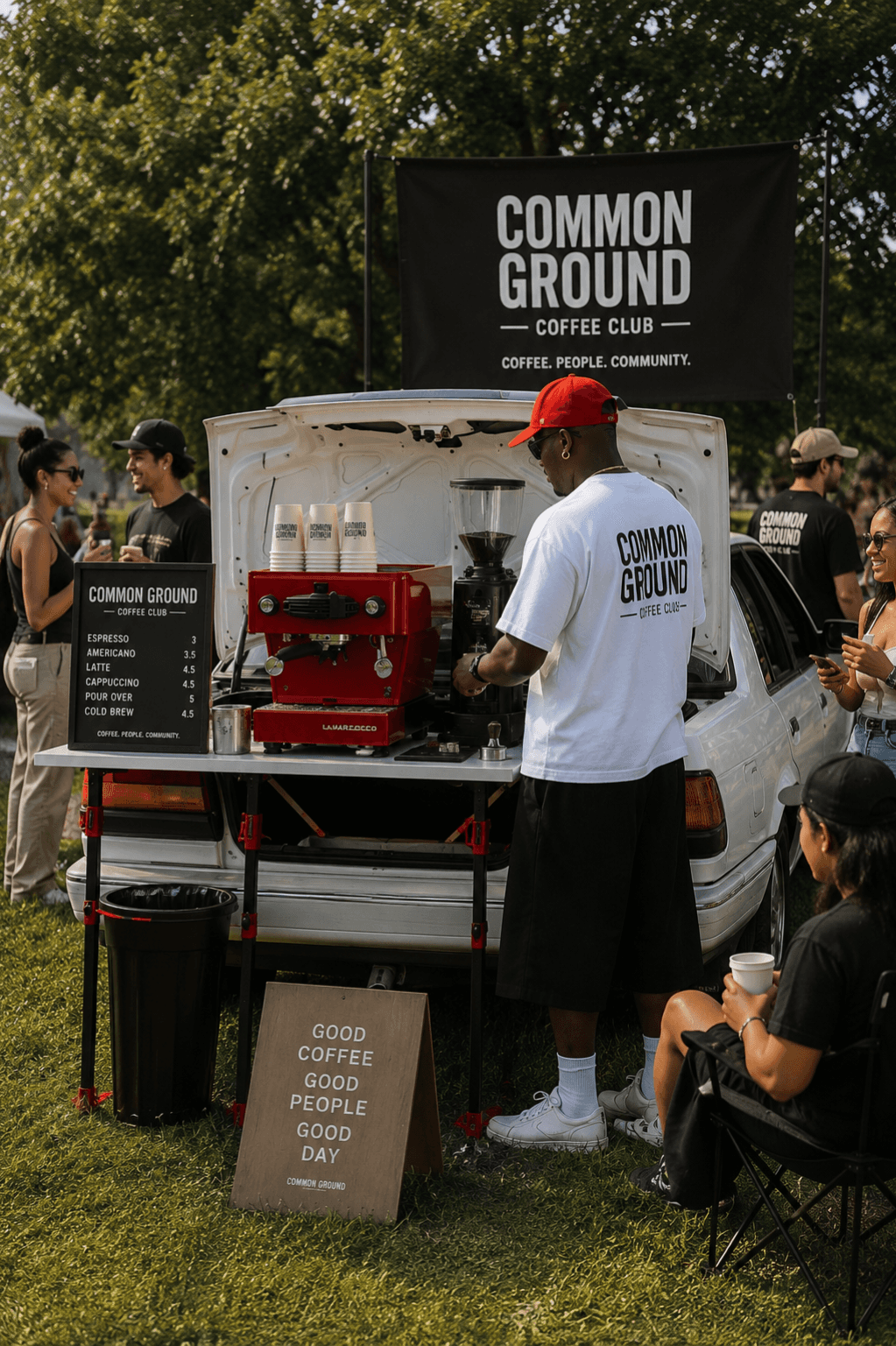
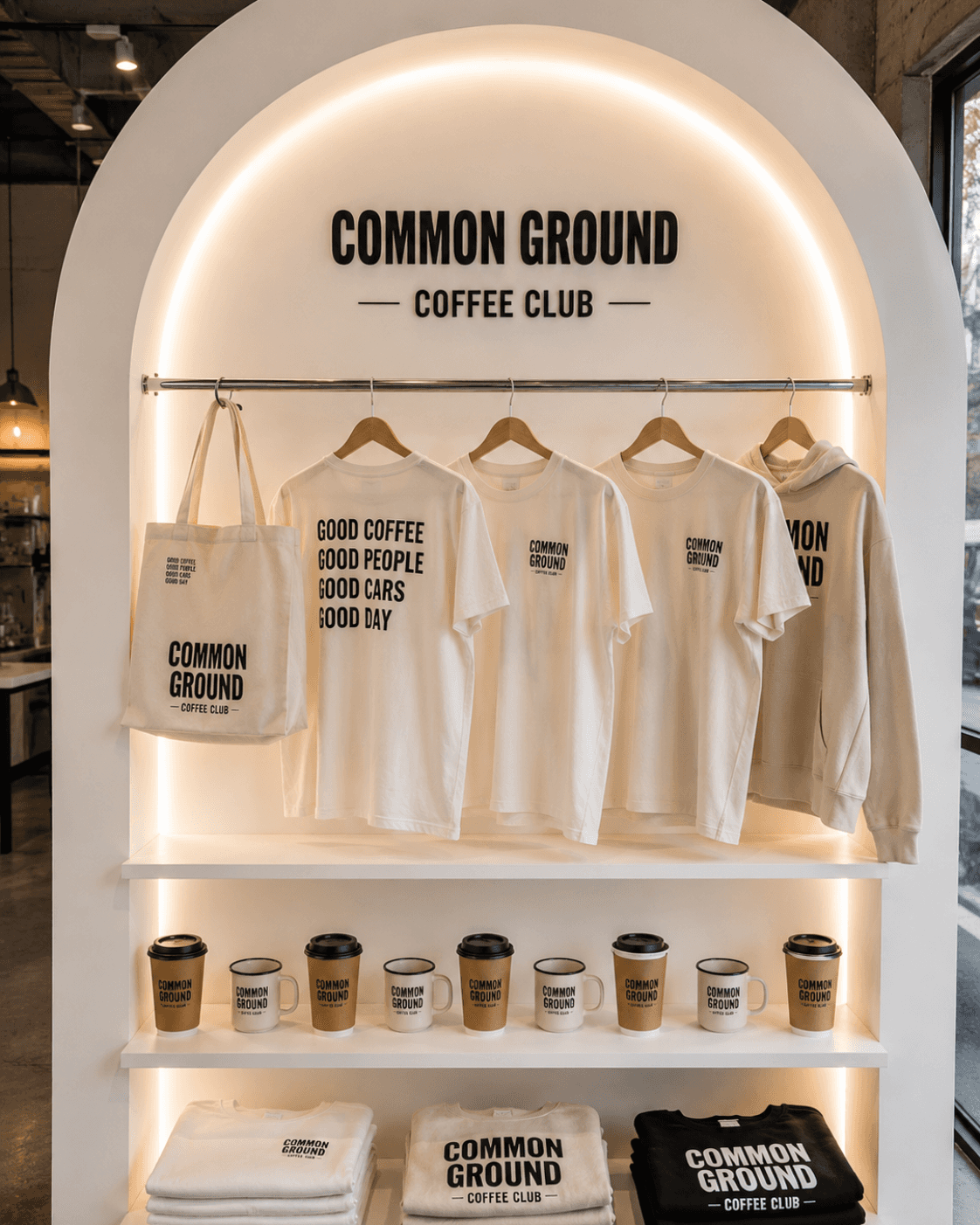
In the Common Ground concept, for example, the same typography and black-and-cream identity could appear across the café signage, shirts, cups, menus and outdoor coffee setup.
Someone taking a photograph of the Porsche is also photographing the Common Ground banner behind it.
Someone taking a picture with friends may have a branded coffee cup in their hand.
Someone filming the coffee setup captures the staff shirt.
The branding becomes part of the environment rather than something added afterward.
5. Create Experiences People Naturally Want to Share
This is where community and marketing start reinforcing each other.
Traditional advertising requires the brand to continually create and distribute content.
A well-designed experience gives customers something worth creating content about themselves.
Consider Coffee & Cars again.
People may photograph:
The cars.
Their outfits.
Their coffee.
Their friends.
The café.
The event signage.
The merchandise.
The DJ.
The crowd.
The brand doesn't have to ask everyone to photograph the logo.
It simply has to make the brand a natural part of the experience they're already photographing.
That's an important distinction.
The best event branding doesn't interrupt the experience.
It becomes part of the experience.
6. Let the Community Generate Your Content
A single event can create far more than one social post.
Before the event, you have:
Event announcements.
Posters.
Countdown graphics.
Behind-the-scenes preparation.
Merchandise previews.
Collaborator announcements.
During the event, you have:
Photography.
Short-form video.
Interviews.
Customer content.
Product shots.
Lifestyle imagery.
Afterward, you have:
Event recaps.
Photo galleries.
Customer reposts.
Highlights.
Announcements for the next event.
One physical event can potentially create weeks of marketing material.
That makes community events particularly interesting for smaller coffee brands that may not have large advertising budgets.
Instead of continuously inventing something to post about, you're documenting something that's actually happening.
7. Give the Community Something They Can Wear
Merchandise becomes much more interesting once a brand has a community around it.
A shirt with a random café logo is merchandise.
A shirt connected to a community someone identifies with can become something else entirely.
It becomes a signal.
"I'm part of this."
That could be a Common Ground Coffee & Cars shirt.
A run-club cap.
A tote from a record-listening event.
A limited poster from a collaboration.
A sticker available only during a particular pop-up.
The object becomes connected to an experience.
And because people can take that object outside the café, the brand travels with them.
8. Collaborate With Communities That Already Exist
A coffee brand doesn't necessarily need to build every audience from zero.
Sometimes the fastest way to create a meaningful event is through collaboration.
A café could partner with:
A local car club.
A running group.
A record store.
A photographer.
A clothing brand.
A creative organization.
A local artist.
A DJ.
A cycling group.
Now both communities have a reason to participate.
The coffee brand brings its customers.
The collaborator brings theirs.
And the event creates a place where those audiences overlap.
This can be particularly useful for newer coffee concepts because you're borrowing distribution, not just adding another name to a poster.
9. Build Recurring Rituals, Not Just One-Off Events
A single successful event can generate attention.
A recurring event can create behavior.
There's a big difference between:
"We're having a Coffee & Cars event."
and
"Coffee & Cars happens here on the first Sunday of every month."
The second one can become a ritual.
People know when it's happening.
They invite friends.
They plan around it.
They recognize familiar faces.
They start expecting the next one.
Eventually, the event itself becomes associated with the brand.
This is where community marketing becomes especially powerful.
You aren't constantly trying to convince people to come back.
You've created something they already expect to return to.
10. Don't Measure Community Only by Attendance
A packed event looks great, but attendance isn't the only thing worth measuring.
A community strategy should eventually contribute to the business.
Look at signals such as:
Repeat attendance — Are people coming back?
Email sign-ups — Are attendees joining something you own?
Social mentions — Are people voluntarily sharing the event?
Customer content — How much usable organic content is being created?
Café visits — Do event attendees return outside event days?
Merchandise sales — Does the community want physical products connected to the brand?
Collaborations — Are other businesses asking to participate?
Referrals — Are existing attendees bringing new people?
The goal isn't simply to create a busy-looking event.
It's to create a community that strengthens the business surrounding it.
11. Community Can Become Part of the Brand Identity
This is where the strategy gets bigger.
Imagine someone discovering Common Ground through Coffee & Cars.
They see the photography.
Then they see the shirts.
Then a friend sends them another event.
Eventually they visit the café.
A few months later, they don't necessarily think of Common Ground as:
"That place that sells coffee."
They think:
"That's the Coffee & Cars place."
Or:
"That's where everyone meets on Sunday."
The community itself has become part of what the brand is known for.
That's positioning.
And unlike a tagline written on a website, people are actually experiencing it.
Coffee Can Be the Product and the Platform
Coffee shops have something many brands would love to have:
a physical place where people naturally gather.
That creates an opportunity.
The café can remain a place to buy coffee.
But it can also become a platform for music, cars, art, design, running, fashion, creativity or whatever culture makes sense for the people the brand wants to attract.
You don't need to manufacture a community out of thin air.
Start with something people already care about.
Give them somewhere to meet.
Create a recognizable experience around it.
Make it worth returning to.
And let the coffee become part of the ritual.
Because sometimes the most powerful thing a coffee brand can sell isn't another cup of coffee.
It's a reason to come back.
Building a Coffee Community of Your Own?
Explore more coffee branding resources, character illustrations, icons and creative assets designed for coffee brands, events and community-driven concepts.
Keep Exploring