Walk into almost any coffee shop and you'll see the familiar pieces of a coffee brand: a logo on the cup, a menu above the counter, branded coffee bags on a shelf and maybe a few pieces of merchandise.
But some coffee brands feel like more than a collection of branded objects.
They feel like a world.
You recognize the personality of the brand before you even read the name. The packaging, illustrations, merchandise and social content all seem to belong to the same place.
One way brands can create that feeling is through character design.
A well-designed character doesn't have to replace a logo. Instead, it can give a brand another visual language—one capable of expressing personality, culture and community in ways a logo alone sometimes can't.
1. A Character Gives the Brand a Personality
A logo tells people who the brand is.
A character can start showing them what the brand is like.
Is the coffee shop quiet and design-focused? Is it built around music? Is it playful? Fashion-forward? Neighborhood-driven? Is it the kind of place where people grab an espresso and leave, or somewhere they spend Saturday afternoon listening to a DJ?
Those ideas can be difficult to communicate through a wordmark alone.
A character gives the brand someone who can actually live inside that world.
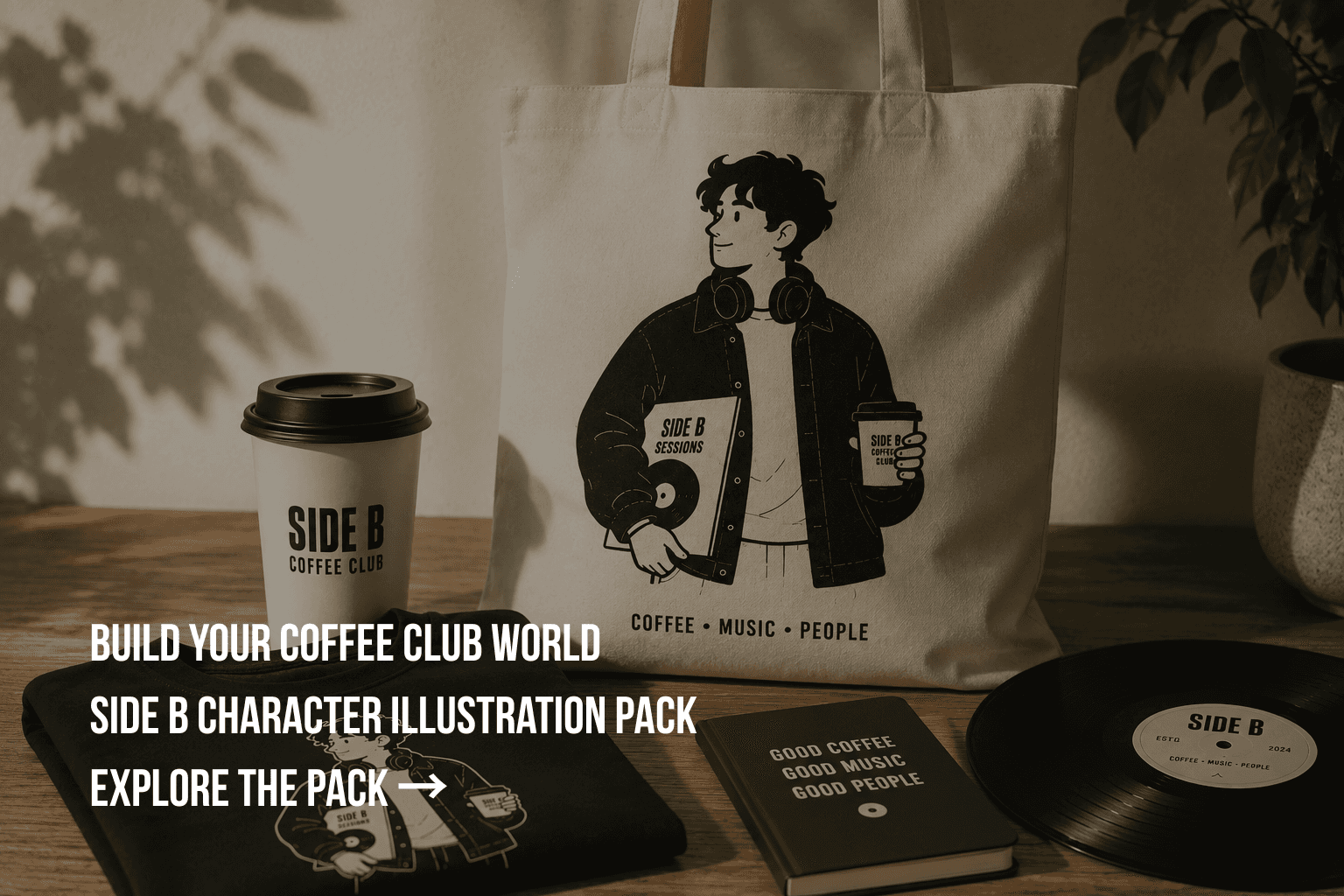
For the Side B Coffee Club character, for example, the personality isn't simply "someone who drinks coffee."
He's into coffee, records, music and community.
He can be shown digging through vinyl, carrying coffee, listening to music, sitting in a café or heading to an event.
Those small scenes start communicating what the imaginary Side B Coffee Club feels like.
2. Characters Make Simple Packaging More Interesting
Coffee packaging doesn't always need complicated graphics.
Sometimes a simple paper cup with one recognizable illustration is enough.
Characters work particularly well here because the packaging becomes a canvas for different moments.
Instead of placing exactly the same logo on every object, a coffee brand could have:
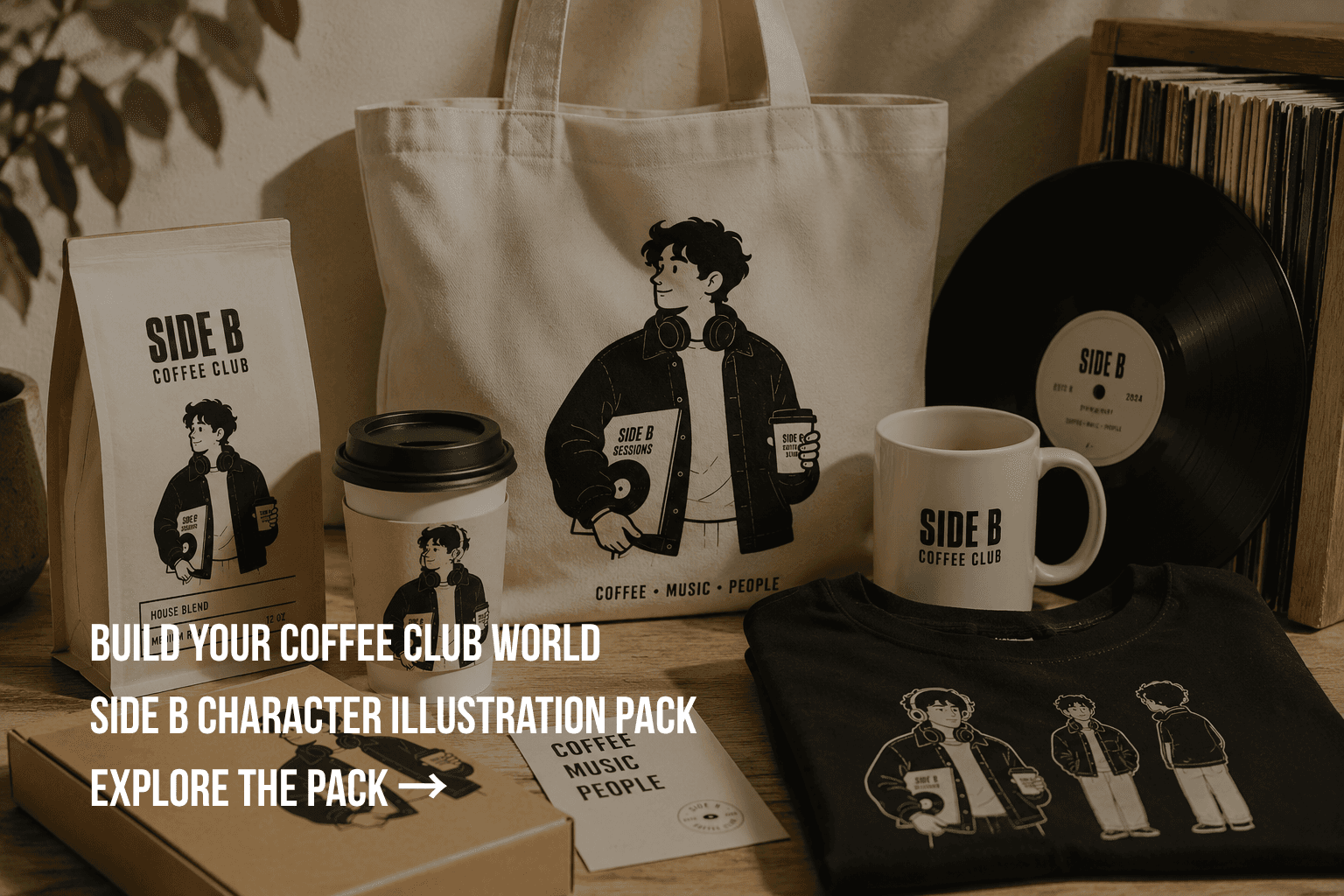
one character illustration on a takeaway cup
another on a coffee bag
a different pose on a sleeve
a small character on a pastry box
another illustration on a tote
Everything still belongs to the same visual system, but it doesn't feel repetitive.
That gives designers room to create variety without constantly reinventing the brand.
3. One Character Can Become an Entire Illustration System
This is where character branding becomes especially useful.
You aren't necessarily designing ten unrelated illustrations.
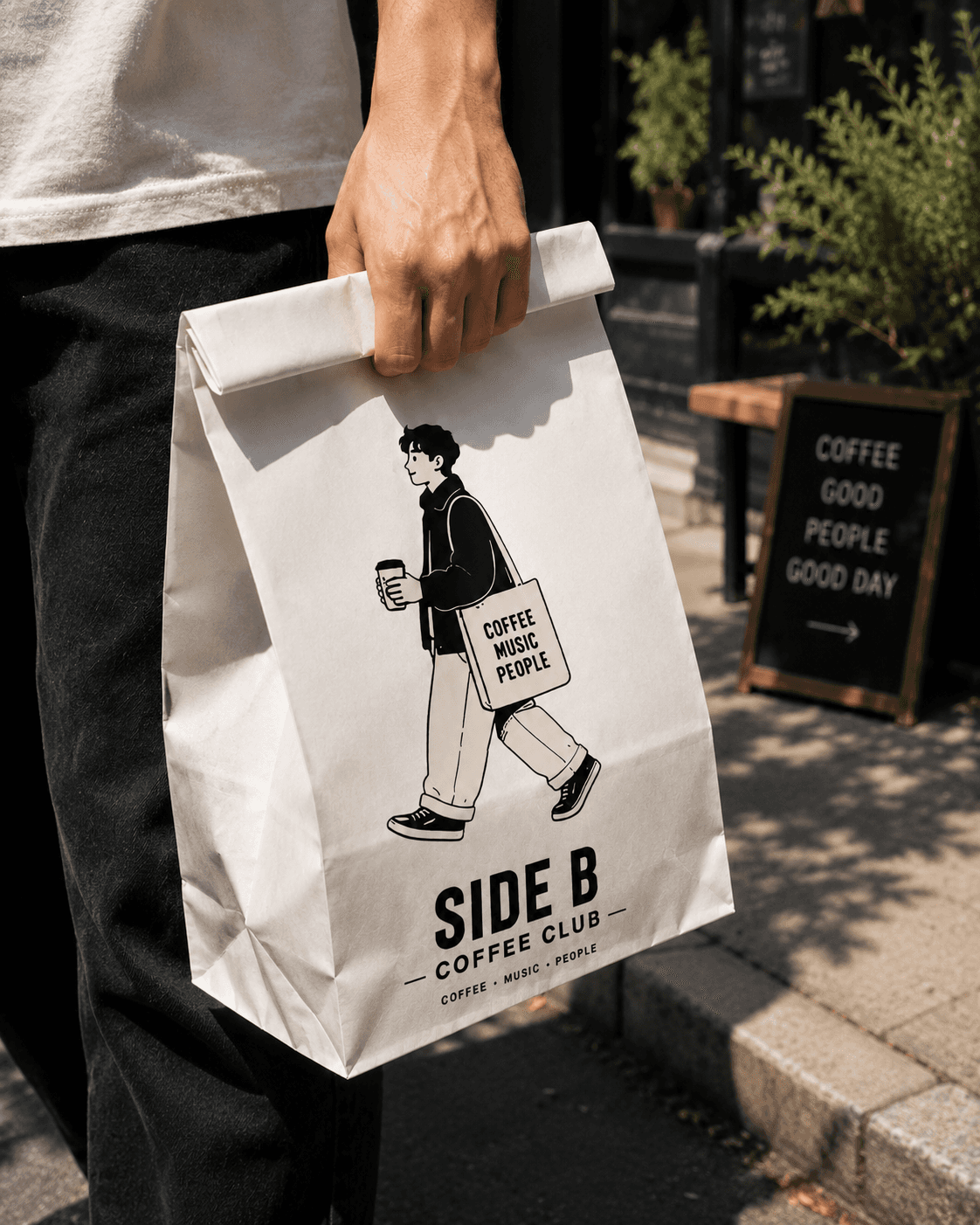
You're designing one recognizable character in ten situations.
Side B might be:
Drinking coffee.
Searching through records.
Listening to headphones.
DJing.
Carrying a tote.
Sitting at a coffee shop.
Walking to an event.
Holding a takeaway cup.
The clothing, hairstyle and illustration style remain recognizable while the activity changes.
That means one character can generate dozens of brand assets.
And suddenly the character isn't just an illustration.
It becomes an illustration system.
4. Characters Can Connect Coffee With Culture
Coffee brands rarely compete on coffee alone.
Many successful independent coffee concepts are also connected to something else:
Coffee + design.
Coffee + music.
Coffee + fashion.
Coffee + cycling.
Coffee + art.
Coffee + community.
That second interest is often what gives the brand its personality.
Character design gives you a visual way to express that intersection.
Instead of writing "We're a coffee brand inspired by music culture" everywhere, the imagery itself can communicate it.
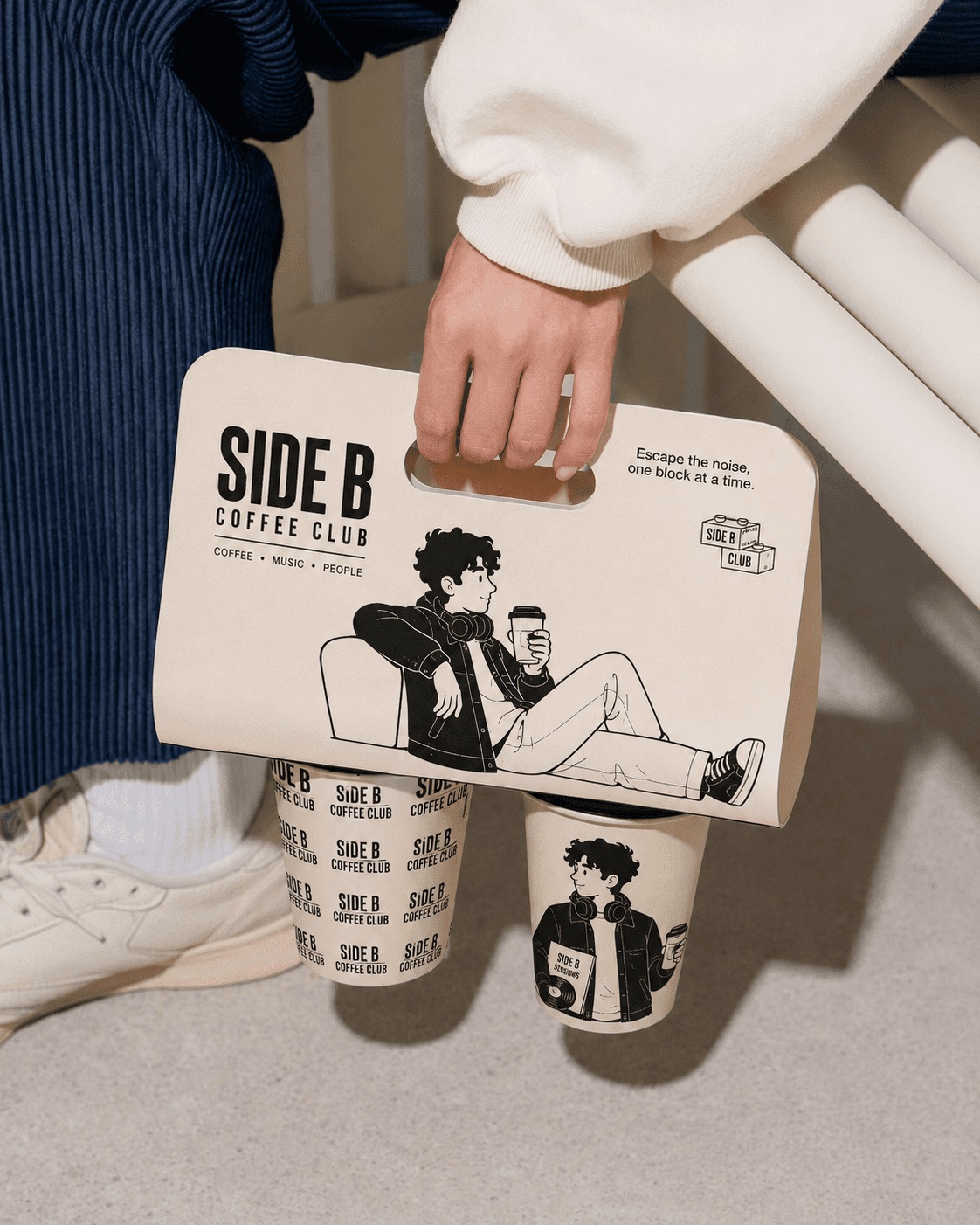
A character carrying a record.
A turntable beside a coffee cup.
Someone wearing headphones while drinking coffee.
A tote that says COFFEE • MUSIC • PEOPLE.
Now the audience can understand the world of the brand without needing a paragraph explaining it.
5. Characters Can Travel Across the Entire Brand
One of the biggest advantages of creating a character system is how many places it can go.
A strong character shouldn't only work on Instagram.
It should still feel recognizable on a tiny coffee cup and a giant poster.
That could include:
Coffee cups and sleeves
A small character illustration can become part of the everyday packaging.
Coffee bags
Different poses could identify blends, roasts or limited releases.
Menus
Small illustrations can create personality without overwhelming the information.
Posters
Characters can become much larger visual elements for events and promotions.
Tote bags and apparel
Instead of simply putting the café logo on a shirt, the character becomes something people may actually want to wear.
Event signage
Character illustrations can connect physical events back to the brand.
Social content
The same character can appear in announcements, event graphics and campaign imagery.
The result is consistency without everything looking identical.
6. Simple Characters Can Actually Be More Useful
More detail doesn't automatically create better branding.
For a character that needs to appear across cups, packaging, posters and digital graphics, simplicity can be an advantage.
Fine details that look beautiful on a large illustration may disappear completely when the artwork is reduced to the side of a coffee cup.
A simpler character can often survive those changes in scale.
That's one reason the same principle behind simple coffee icons also applies to characters:
Recognition matters more than complexity.
The silhouette should be understandable.
The clothing should remain recognizable.
The illustration style should remain consistent.
And the character should still feel like the same person whether they're printed three inches tall or displayed across a large poster.
7. Characters Give You Something to Build On
A logo has to remain relatively consistent.
Characters can evolve.
That's where things get interesting.
A coffee brand might begin with one character and five illustrations.
Later, that can become:
Seasonal illustrations.
New outfits.
New activities.
Event-specific artwork.
Collaborations.
Additional characters.
Sticker collections.
Merchandise drops.
Limited-edition packaging.
Eventually, customers aren't only recognizing the visual identity.
They're recognizing the world surrounding it.
That creates opportunities for the brand to continually release something new without abandoning its existing identity.
The Goal Isn't to Create a Mascot
When people hear "brand character," they sometimes imagine a traditional cartoon mascot sitting beside a company logo.
It doesn't have to work that way.
For lifestyle-oriented coffee brands, the character can be much subtler.
Think of the character as someone who represents the world you're building.
What do they wear?
What music do they listen to?
Where do they spend their Saturday?
What are they carrying?
What would be sitting on the table beside their coffee?
Those decisions communicate brand positioning.
And when they're repeated consistently, the audience starts understanding the brand without needing to be told.
Build a World, Not Just a Logo
The strongest coffee identities don't necessarily have the most complicated branding.
They have recognizable ingredients that appear again and again.
A typeface.
A color.
An icon.
A packaging style.
A character.
A particular photographic direction.
Each piece reinforces the others.
Characters are especially powerful because they can move through that system. They can hold the coffee, wear the merchandise, appear at the event and become part of the packaging.
Instead of simply showing people what the coffee brand looks like, you're showing them what it might be like to belong to it.
Want to Experiment With Character-Led Coffee Branding?
The Side B Coffee Club Character Illustration Pack was created as a flexible set of character illustrations for coffee brands, events, merchandise and community-focused projects.
Use the characters across packaging, posters, apparel, social graphics and other brand applications.
Explore the Side B Coffee Club Character Pack →